Short answer: an NFC business card costs more per unit than a printed card, but it is the only format that lands your details inside the recipient’s phone in about two seconds and can be updated afterwards. Compare them on cost per retained contact, not cost per card.

Key takeaways
- A tap puts your profile in the recipient’s phone in about two seconds — no typing, no app.
- Links and chip content can be rewritten; a paper card needs a reprint every time details change.
- Tap analytics show which meetings and events produced saved contacts — paper gives no signal.
- NTAG215 is the sensible default: enough capacity for a full vCard without paying for unused space.
- Pair digital with a small batch of matching paper cards rather than replacing print entirely.
Where NFC genuinely wins

- The contact actually lands. A paper card sits in a wallet or a drawer. An NFC tap puts your details into the recipient’s phone in about two seconds.
- You can update it. Change your title, phone number or portfolio link — rewrite the chip, or change where the URL points. A paper card requires a reprint every time.
- You can measure it. Tap analytics tell you which events, meetings or campaigns produced saved contacts. For a small business without a CRM, this substitutes for one in the early stages. Paper offers no signal at all.
- It holds more than a card can print. A vCard with photo, multiple numbers, social profiles, a booking link and a portfolio — a paper card can’t carry that. An NTAG215 or NTAG216 can.
- No app on the recipient’s side. Modern iPhones (XS and newer) and most Android phones read NFC tags in the background. The person you just met doesn’t install anything.
Where it doesn’t — an honest view
- NFC isn’t always switched on. Some users have it disabled, and some older or budget phones behave inconsistently. This is why QR fallback matters: print a QR code pointing to the same link and the card works either way.
- Unit cost is higher than paper. A printed card costs cents. An NFC card costs more, and a metal or wooden card considerably more. The comparison only makes sense on cost per retained contact.
- It is still a physical object that can be lost. The advantage is what happens before it is lost — the details are already in the phone. But if the card is never tapped, it delivers nothing.
- Paper still makes sense sometimes. Bulk giveaways at a trade-show booth, a corporate gift box where print aesthetics matter, or formal settings where pulling out a phone feels wrong.
- Pairing beats replacing. Most businesses are better off combining a digital card with a small batch of matching paper cards instead of choosing one over the other.
Choosing the material

| Material | Character | Typical use | Considerations |
|---|---|---|---|
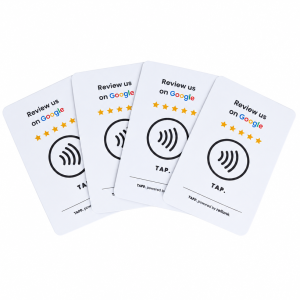
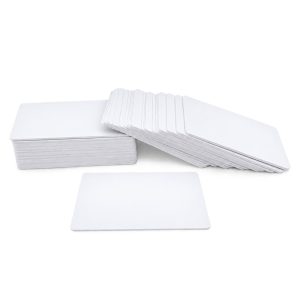
| PVC | Standard card feel, full-colour print | Team rollouts, volume orders, resale programmes | Lowest unit cost; most flexible on quantity |
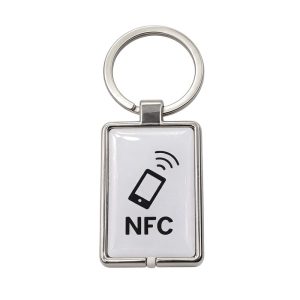
| Epoxy / dome | Glossy raised surface | Branded cards, premium hand-outs | Durable and tactile; slightly higher cost |
| Metal | Weight and permanence | Executive cards, high-end branding | Highest cost; needs anti-metal construction for reliable reads |
| Wood / bamboo | Natural, distinctive | Eco-positioned brands, hospitality | Engraving rather than full-colour print |
| Acrylic | Transparent, modern | Design-led brands, display pieces | Premium presentation; higher unit cost |
Technical note — a standard NFC inlay inside or on a metal body will read badly or not at all unless the construction includes a shielding layer. If a supplier quotes a metal NFC card without mentioning anti-metal construction, ask how they handle it.
Which chip
It comes down to what the card carries.
- A single profile link or URL — NTAG213 is sufficient and the most cost-effective at volume.
- A full vCard stored on the tag — Name, title, phone, email, website, social links — NTAG215. This is the common choice for digital business cards.
- vCard with photo, multiple addresses or multi-language records — NTAG216.
For most business card programmes, NTAG215 is the sensible default: enough capacity for a complete profile without paying for unused space.
What drives cost on a bulk order
Four variables, in rough order of impact:
- Material — PVC at the low end, metal at the high end, with a wide spread between.
- Quantity — unit cost drops meaningfully at 500 and again at 1,000+.
- Printing and finishing — full-colour UV print, spot colours, engraving, numbering, variable data (each card a different link).
- Chip and construction — NTAG215 over NTAG213, and anti-metal layers for metal bodies.
Encoding and tap-testing before dispatch is usually included on volume orders. Confirm it, because it is the step that prevents a box of cards that don’t work.
Questions worth asking a supplier
- Can each card carry a different link (variable encoding for a team)?
- Is the chip specified on the quotation?
- Is QR fallback included, and is it static or dynamic?
- Is the card locked to read-only, or can links be updated later?
- Are units encoded and tap-tested before shipment?
- What is the sample lead time, and are samples charged?
Frequently asked questions
Do NFC business cards work with iPhone and Android?
Yes. iPhones from the XS onwards and most Android phones read NFC tags in the background — the recipient does not install an app. A QR code printed on the card is still recommended as a fallback for phones with NFC disabled.
Can I update the link on an NFC business card later?
Yes, if the card is left writable or if the chip points to a URL you control. You can rewrite the chip or redirect the URL. If a supplier locks the card to read-only, the content is fixed — ask before ordering.
Which chip should I choose — NTAG213, NTAG215 or NTAG216?
NTAG213 for a single URL, NTAG215 for a full vCard stored on the tag, NTAG216 for a vCard with photo, multiple addresses or multi-language records. NTAG215 is the usual default for digital business cards.
How much do NFC business cards cost compared with paper?
A printed card costs cents; an NFC card costs more, and metal or wood considerably more. The fair comparison is cost per retained contact rather than cost per unit, because one tap that lands a saved contact replaces dozens of paper cards that never convert.
Do I need a QR code on the card?
Yes. Some users have NFC disabled and some older or budget phones read tags inconsistently. A QR code pointing to the same link means the card works either way.
Do metal NFC cards work reliably?
Only with anti-metal construction. A standard inlay on or inside a metal body will read badly or not at all unless a shielding layer is built in. Always confirm how the supplier handles this.
What is the minimum order quantity?
For printed PVC cards, 200 pcs per design is typical; custom OEM builds usually start at 500 pcs. Unit cost drops meaningfully at 500 and again at 1,000+.
Are the cards encoded and tested before shipping?
They should be. Encoding and tap-testing before dispatch is normally included on volume orders and is the step that prevents a box of cards that do not work. Confirm it in writing before you order.
Where LOZAVY fits
LOZAVY has manufactured RFID and NFC cards, inlays and tags for over 16 years, with in-house chip encapsulation, printing, die-cutting and forming. We produce NFC business cards across PVC, epoxy, metal, wood and acrylic, in NTAG213/215/216, with custom shapes, full-colour or engraved finishes, variable per-card encoding, QR fallback and anti-metal constructions. We also supply the matching paper cards for the settings where print is still the right answer — the pairing works better than a straight replacement. Tell us your material, quantity and profile link, and we will quote and prepare tested samples.
Get a quote and tested samples
Tell us your material, quantity and profile link — we will come back with a buildable option and a quote.
Sources: NFC business card category data and B2B platform sales volumes, September–October 2026. iPhone background tag reading applies to iPhone XS and newer. Specifications should be confirmed against current NXP datasheets for your order.